wellness
Montmartre's Steep Streets Transform Daily Walks Into Powerful Mindfulness Practice
Montmartre's steep streets and garden terraces turn out to be surprisingly good therapy, if you know how to use them.
How we reported this
The average Montmartre resident walks roughly 6,000 steps a day getting from the Abbesses métro to the market, up the Rue Lepic, back down toward the Place du Tertre. Most of those steps are spent checking a phone. A growing movement of wellness practitioners and neuroscientists argues that's a significant waste of a powerful mental health tool hiding in plain sight.
Walking meditation, the deliberate practice of anchoring full attention to the physical act of moving through space, has existed in Buddhist traditions for more than 2,500 years. It's showing renewed urgency right now because screen fatigue and ambient financial anxiety are squeezing people who can't afford weekly therapy sessions or a monthlong retreat in Provence. The practice costs nothing. It requires no equipment. And Montmartre, with its cobblestones, staircases, and sudden panoramic views, happens to offer ideal conditions.
What the Science Actually Says
A 2024 meta-analysis published in the journal Mindfulness reviewed 27 randomised controlled trials and found that walking meditation produced statistically significant reductions in self-reported anxiety scores compared to unstructured walking, a mean reduction of 18 percent after eight weeks of consistent practice. That's not trivial. For context, a standard eight-week Mindfulness-Based Stress Reduction course, which typically costs between €350 and €500 in Paris, produced comparable anxiety outcomes in several of the same trials.
The mechanism isn't mysterious. Deliberate attention to sensory input, the texture of a stone underfoot, the resistance of an incline, the temperature of morning air on the Rue Caulaincourt, interrupts the brain's default mode network, the neural circuitry responsible for rumination and worry. You're essentially rebooting a system that's been stuck in a loop.
The practice differs from ordinary walking in one critical way: pace. Most instructors recommend slowing to roughly half your natural walking speed for at least the first ten minutes. Each step breaks into three distinct phases, lifting, moving, placing, and the practitioner names those phases silently. It sounds absurd until you try it on the Montmartre vineyard path along the Rue des Saules on a quiet Tuesday morning, and suddenly the city around you sharpens into something almost cinematic.
Where to Start in the 18th
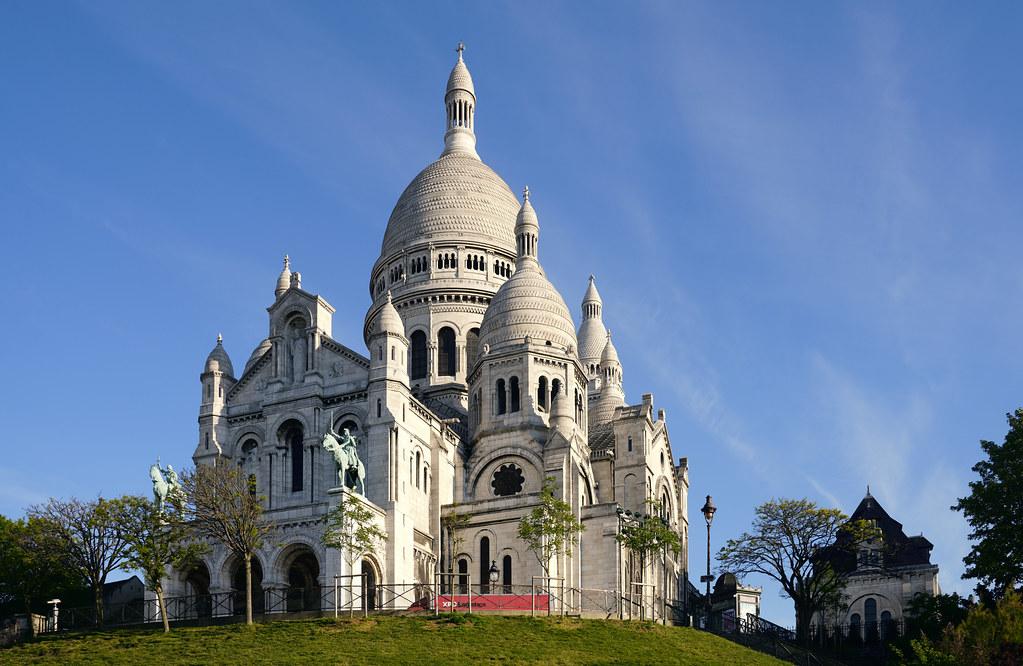
The Square Louise Michel, the terraced garden descending from the base of Sacré-Cœur, is the most obvious venue, 300 metres of gentle slope, relatively uncrowded before 9am, with the added advantage of a fixed visual anchor at the top. Practitioners who find their attention drifting are advised to use a distant point, like the dome of the basilica itself, as a soft focal reset.
For those who prefer a less touristic route, the Jardin Naturel Pierre-Emmanuel on the Rue Duranti offers 2,800 square metres of wild-planted green space tucked behind the eastern edge of the butte. It's largely unknown to visitors and rarely crowded even on weekends. The uneven ground there, deliberately unmaintained to encourage biodiversity, actually enhances the practice by demanding more physical attention with each step.
The Centre Bouddhiste de Paris, based in the 13th arrondissement but running monthly sessions in the 18th since March 2025, offers free guided walking meditation workshops on the third Saturday of each month. The next session falls on July 19. Registration opens through their website two weeks prior and typically fills within 48 hours.
Starting solo requires almost nothing. Choose a route you know well enough that navigation is automatic. Leave headphones at home. Begin at a standstill, take three slow breaths, then move. Keep your gaze soft, directed roughly two metres ahead on the ground. When a thought pulls you away, and it will, constantly, simply return attention to the lift, move, place of the next step. Set a timer for 15 minutes the first time. Most people find the session ends before it feels like enough.
The Rue Lepic from the Place Blanche up to the Moulin de la Galette covers exactly that 15-minute window at a meditative pace. It's noisy, uneven, and alive with the smell of bread from the boulangeries. Which is, practitioners will tell you, entirely the point. The practice isn't about finding silence. It's about learning to be fully present inside the noise you already live in.
For personalised guidance, consult a qualified wellness professional or mental health practitioner based in your area.